


Traveling endospores at the heart of the gas networkAn IPREM team discovers an unknown bacterium traveling through European gas pipelines
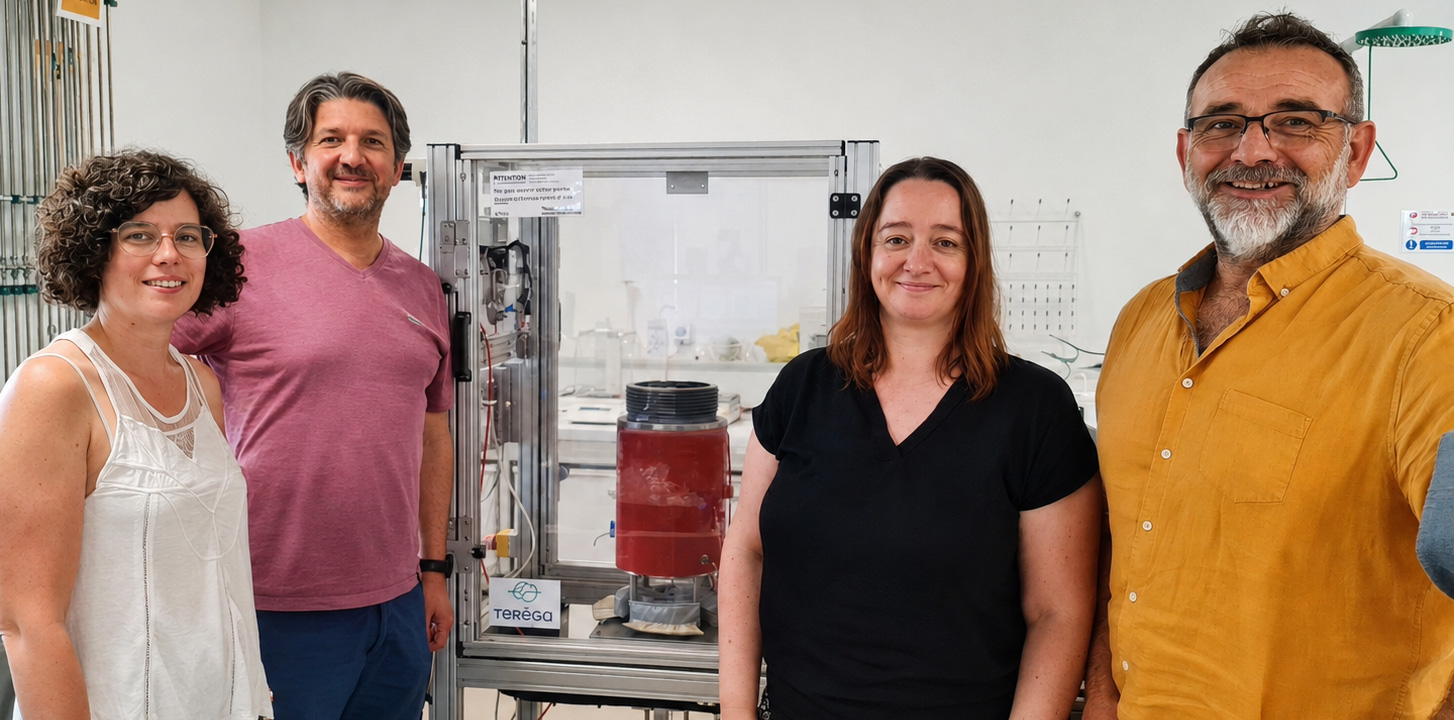
A research team from the Institute of Analytical Sciences and Physical Chemistry for the Environment and Materials (IPREM) has discovered a previously unknown bacterium traveling in endospore form through European gas pipelines. This world-first discovery reveals that our gas networks serve as biological highways, a key issue for the future geological storage of hydrogen.
By the Numbers
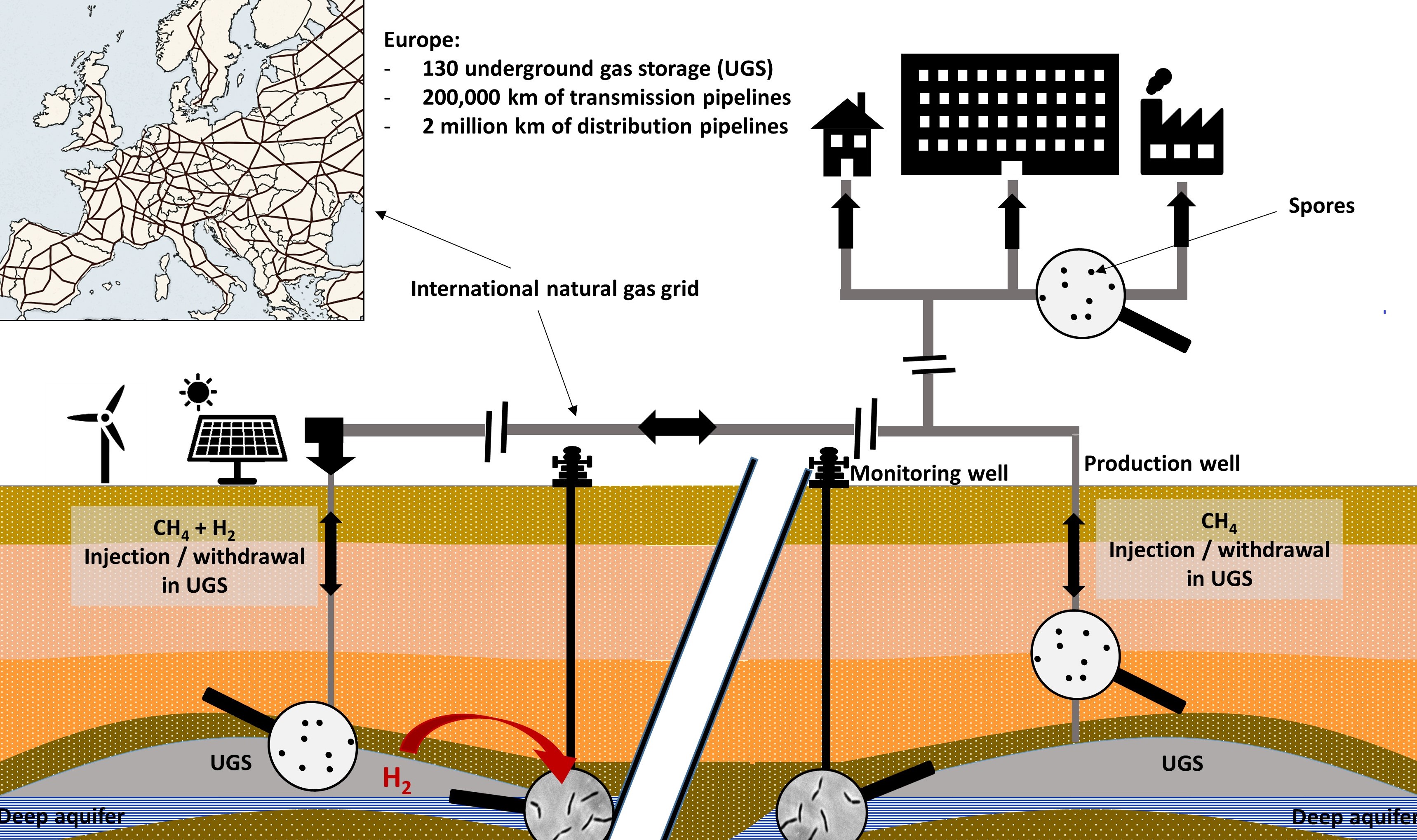
- 130 geological gas storage sites in Europe,
- 200,000 km of pressurized transmission pipelines,
- 2 million km of distribution pipelines,
- 332 billion cubic meters of gas transported in 2024.
A Discovery at the Heart of the Energy Transition
Transnational natural gas transmission networks constitute an extremely hostile industrial environment. Subjected to pressures of up to 80 bars, drastic chemical dehumidification treatments, and a resulting near-total absence of water, these millions of kilometers of steel pipelines had, until now, seemed incompatible with life. However, a research team from IPREM, as part of the SEnGA joint laboratory in partnership with Teréga, has challenged this assumption by revealing unexpected biological connectivity within the European gas network.
The major technological hurdle initially lay in the sampling methodology. Through the development of a novel, sterile, and secure sampling platform—designed to comply with explosive atmospheres (ATEX) regulations—the researchers were able to isolate microorganisms directly from the pressurized gas stream: a world first.
Genomic analyses revealed a completely unknown bacterium (representing a novel species and genus) belonging to the Peptococcaceae family. To survive the extreme conditions of the pipeline network and travel hundreds of kilometers between southwestern France, the Paris Basin, and northern Italy, this microorganism employs a formidable survival strategy: it travels in the form of an endospore, an ultra-resistant dormant structure. Once it reaches a favorable environment, such as vast underground geological storage reservoirs (deep saline aquifers or depleted hydrocarbon reservoirs), the endospore “wakes up” (germinates) to complete its life cycle.
A hydrogeno-trophic bacterium
The significance of this discovery extends far beyond biological curiosity: it lies at the heart of the energy transition. This bacterium is hydrogenotrophic, meaning it metabolizes carbon dioxide and hydrogen. Future decarbonization scenarios rely on the massive injection of green hydrogen into these very same geological storage sites. Tests in pressurized reactors revealed that this microorganism responds to an increase in hydrogen partial pressure by adapting its metabolism to produce formate. This molecule is capable of directly influencing the microbial equilibrium, the geochemistry of the formation waters, and the quality of the stored gas.
By demonstrating that our energy infrastructure acts as a veritable highway for the dispersal of life within the deep biosphere, this pioneering study provides essential insights for anticipating and securing the energy storage systems of tomorrow. It also highlights how human activity has, once again, bypassed natural biogeographical barriers by connecting subsurface ecosystems that had been isolated for millions of years.
Bibliography
Magali Ranchou-Peyruse, Marion Guignard, Guilhem Caumette, Pierre Chiquet, Pierre Cézac, Anthony Ranchou-Peyruse, Gas pipelines, highways for hydrogenotrophic spore-forming bacteria, ISME Communications, Volume 6, Issue 1, January 2026, ycag006